Explain what will happen leading up to the eruption
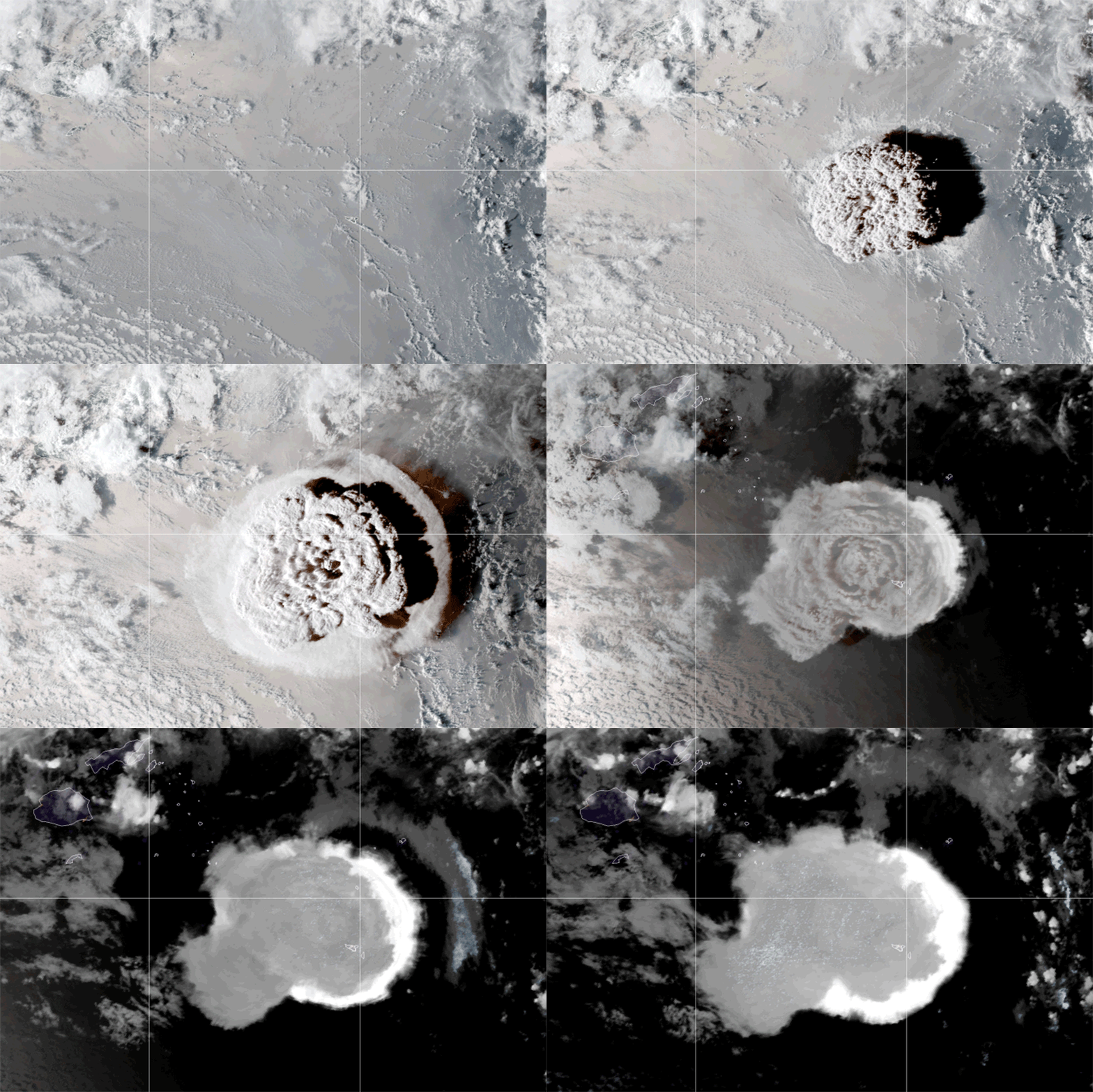
The Hunga Tonga–Hunga Ha'apai explosion was captured past several Earth-observing satellites. Credit: Visible World/NASA
The eruption that devastated Tonga on 15 January lasted just xi hours, but it will take years for scientists to work out exactly what happened during the cataclysmic explosion — and what information technology means for hereafter volcanic risks.
The volcano, named Hunga Tonga–Hunga Ha'apai, sent a feather of ash soaring into the upper temper and triggered a tsunami that destroyed homes on Tonga's nearby islands. Reverberations from the eruption circled the earth multiple times.
The extraordinary power of the blast, captured by a range of sophisticated Earth-observing satellites, is challenging ideas most the physics of eruptions. Researchers are finding it hard to explain why the volcano sent a cloud to such heights, yet emitted less ash than would be expected for an eruption of such magnitude. And the shock waves that rippled through the atmosphere and oceans are unlike annihilation seen in the modern scientific era.
The eruption of Hunga Tonga–Hunga Ha'apai is forcing scientists to rethink their ideas on the hazards posed past the many submarine volcanoes that lurk beneath the waves of the Pacific Ocean.
"It merely basically rips the Rough-and-tumble on our lack of understanding of what's happening nether water," says Nico Fournier, a volcanologist at GNS Scientific discipline in Taupo, New Zealand.
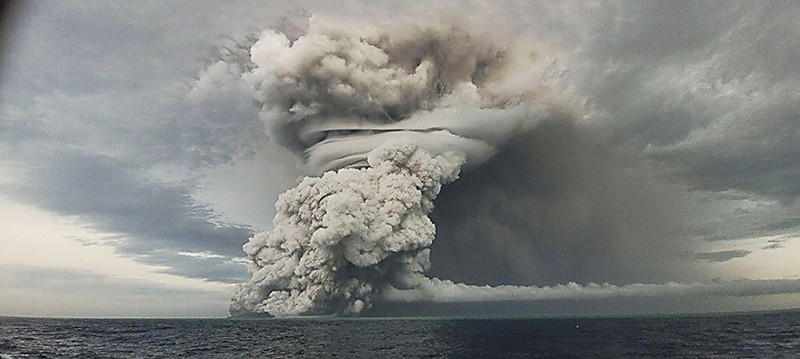
Tongan scientists observed an eruption of the volcano a day before the principal blast. Credit: Tonga Geological Services/ZUMA Printing
Fresh danger
The eruption, which happened just 65 kilometres from the Tongan uppercase of Nuku'alofa, has been a disaster for the more than than 100,000 people living in Tonga. They are working to clear away the thick layer of ash that blanketed everything, to plant clean drinking-water supplies and to recover from the crop damage, estimated to equate to nearly 39 1000000 Tongan pa'anga (US$17 million). At least iii people have died in Tonga as a consequence of the eruption. The crisis is beingness compounded by COVID-xix, with Tongans facing their first wave of cases, which started later on relief ships arrived from other countries.
Merely earthquakes go along to milk shake the region, and the volcanic danger might not be over. Preliminary studies of ash from the xv January eruption advise that it was fed by a fresh batch of magma ascent from inside Earth. Hunga Tonga–Hunga Ha'apai could remain active for some time, with uncertain effects on the people of Tonga.
Geoscientists have limited ability to provide people in the region with a practiced sense of the future risks. "It's a actually difficult state of affairs of wishing volcanology could give more to the local people," says Janine Krippner, a volcanologist with the Smithsonian Institution's Global Volcanism Program in Washington DC, who is based in New Zealand. "But right now, that's not the case."
Near of Hunga Tonga–Hunga Ha'apai lies under water. It rises more than two,000 metres from the sea floor and is part of the Tonga–Kermadec volcanic arc. This string of mostly underwater volcanoes sits above a massive geological standoff zone, where the western edge of the Pacific plate of Earth's crust dives beneath the Indo–Australian plate. The edge of the Pacific plate heats up as it sinks into the planet's depths, and molten rock rises to feed the volcanoes of the Tonga–Kermadec arc.
Geological testify shows that large eruptions have convulsed Hunga Tonga–Hunga Ha'apai about in one case every millennium, with huge blasts that occurred in around advertizing 200 and ad 1100. The by century has brought smaller ones, in 1937 and 1988. By that point, the top of the volcano was peeking out higher up the waves in the form of two small islands, named Hunga Tonga and Hunga Ha'apai.
Then, in 2009, the volcano began spitting ash and steam in an eruption at Hunga Ha'apai. In December 2014 and January 2015, another eruption formed new state that continued the two islands, forming a single landmass1 , ii.
Several inquiry teams visited the new island shortly after it formed and gathered samples of volcanic ash and rock. Geochemical assay of that cloth, described in a paper in Lithos 3, found that the 2009 and 2014–15 eruptions involved molten rock that had not risen recently from the cracking depths of Globe's mantle.
Instead, information technology had spent some time at a geological manner station, a magma bedroom located 5–8 kilometres deep in Earth'south crust. While sitting in that location, the magma had gone through some tell-tale chemical changes, almost like wine ageing in a barrel, before ultimately erupting onto the surface.
The magma that erupted this Jan was dissimilar. Shane Cronin, a volcanologist at the University of Auckland in New Zealand, and his colleagues have analysed ash from the eruption that military relief workers scooped up near the drome on Tonga's largest island. Chemical analysis shows that information technology differs from that of the 2014–15 eruptions. Cronin says that the fresh magma rose apace, without spending much time undergoing chemical changes in the buried magma chamber.
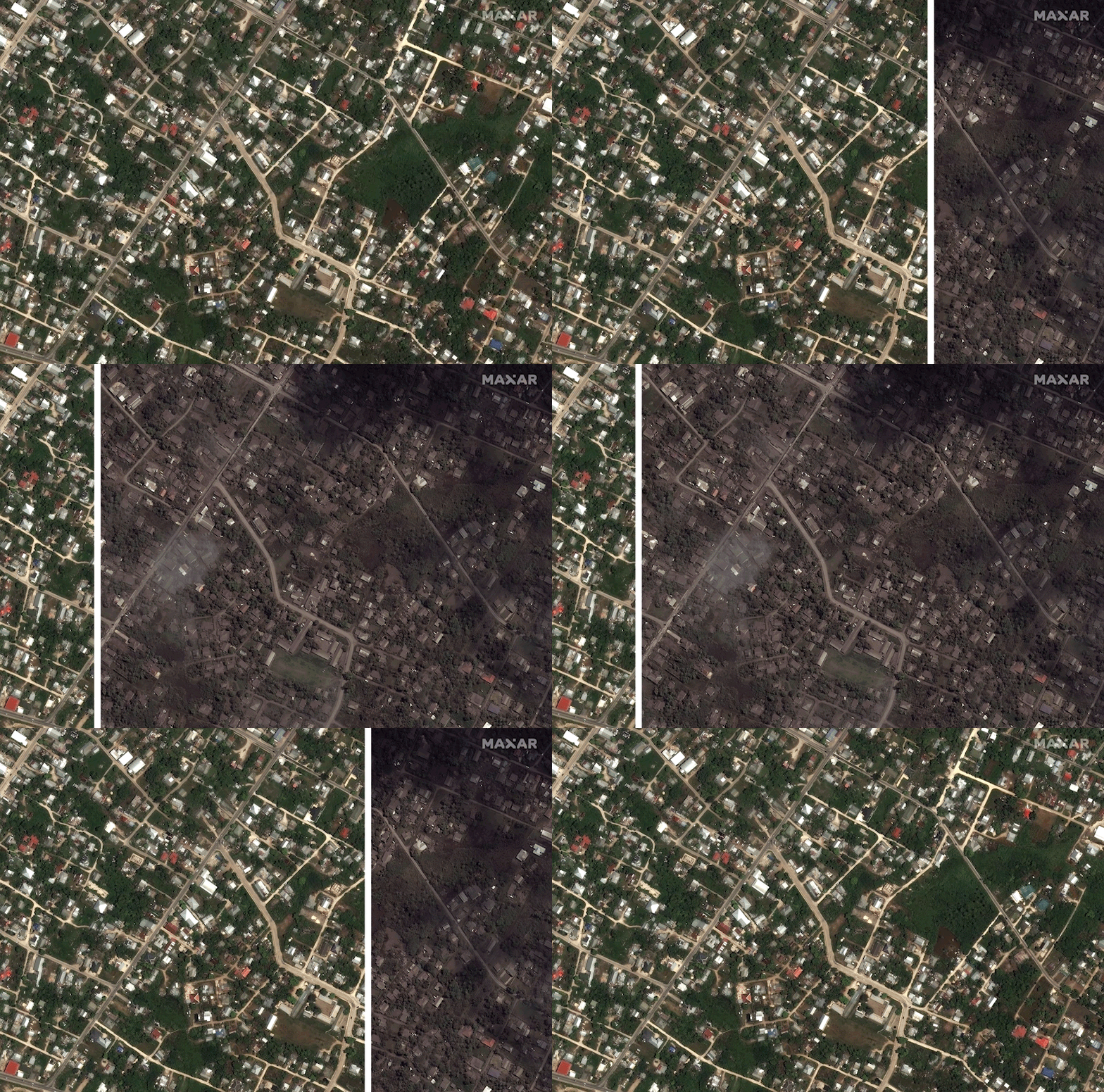
Tongatapu isle in Tonga before Tonga–Hunga Ha'apai exploded, and later on, covered in ash. Credit: Maxar via Getty
Geologist Taaniela Kula and his colleagues at the Tonga Geological Services in Nuku'alofa have been collecting ash samples from islands across Tonga that Cronin and others are analysing. Past studying ash from different islands, including noting how thickly and how widely it is distributed, researchers will be able to build up a amend movie of how the eruption unfolded.
Surprisingly, there seems to have been relatively little ash emitted, given the size of the blast. That might be a result of the surround in which Hunga Tonga–Hunga Ha'apai erupted: under water, but at a relatively shallow depth.
The water factor
Volcanoes in deep water rarely erupt through the ocean surface in big blasts, because the pressure of the overlying water prevents gas bubbles from forming and growing with explosive force. But the volcanic vent that erupted at Hunga Tonga–Hunga Ha'apai on 15 January was only tens to 250 metres deep. That'south shallow enough that the water didn't suppress the power of the blast, only deep plenty for the erupting magma to meet a lot of water.
Water can fuel explosive eruptions by flash-heating to form steam, which expands rapidly. In this style, it efficiently transforms thermal energy from magma into the kinetic energy of an eruption, says Michael Manga, a geoscientist at the Academy of California, Berkeley. "Some of the most powerful eruptions have been through h2o," he says.
Another important cistron is how much volcanic gas is mixed into the magma earlier it erupts. A gas-rich upwelling of magma might have fed the fifteen January eruption past providing a large number of bubbling to fuel the explosion, says Raymond Cas, a volcanologist and emeritus professor at Monash University in Melbourne, Australia.
The eruption of Hunga Tonga–Hunga Ha'apai is unusual in that it combined features not usually seen together, says Cas. Volcanologists know of other examples of eruptions that occurred under h2o, or under snow and ice, and thus incorporated water. Scientists have also seen extremely high eruption plumes that towered into the atmosphere. Just Hunga Tonga–Hunga Ha'apai is a unique instance of both things happening together. It might ultimately come to serve equally the prototype of a newly recognized type of eruption fashion, he says.
Most submarine eruptions don't produce particularly loftier plumes. For instance, in 2012 the massive deep-body of water eruption of Havre volcano, north of New Zealand, produced mainly a huge floating collection of lightweight pumice stonesiv. That eruption occurred at a depth of more than 900 metres. "We have relatively few cases where nosotros see large plumes that breach the ocean surface," says Kristen Fauria, a volcano scientist at Vanderbilt University in Nashville, Tennessee.
Yet the Hunga Tonga–Hunga Ha'apai eruption plume soared to a height of at least thirty kilometres, well into the upper atmosphere, or stratosphere. That'south so high that researchers have been scrambling to understand what long-term touch it might take. Loftier-resolution satellite imagery is allowing them to rail how ash, gas and certain chemic species are drifting through the atmosphere — in much more detail than they could in 1991, when Mount Pinatubo in the Philippines erupted fifty-fifty more than powerfully than Hunga Tonga–Hunga Ha'apai. "Nosotros have never seen anything like this," says Anja Schmidt, a volcanologist at the German Aerospace Center in Oberpfaffenhofen.
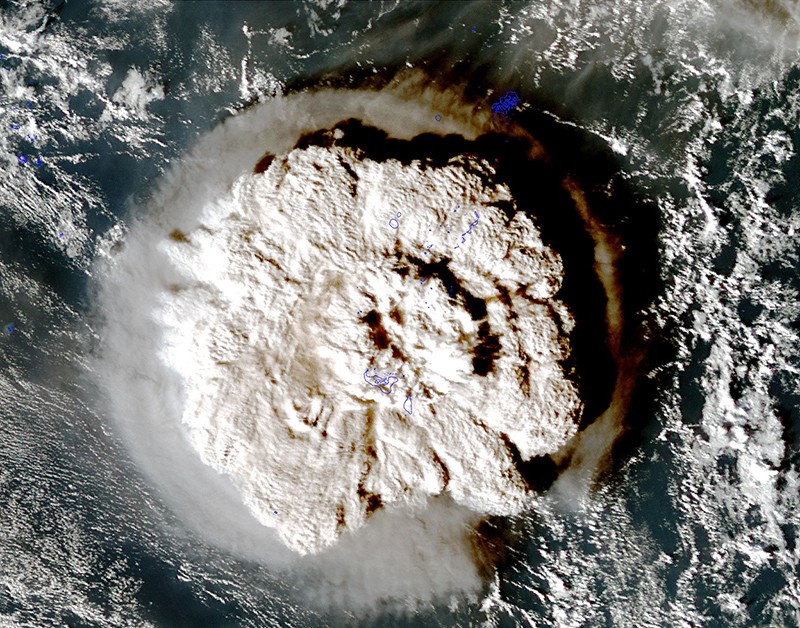
The giant ash cloud that erupted from Hunga Tonga–Hunga Ha'apai, taken by the Japanese satellite Himawari-8. Credit: EyePress News/Shutterstock
The Tonga volcano didn't emit enough sulfur dioxide to modify global climate, as eruptions from another volcanoes have. It expelled an estimated 400,000 tonnes of SO2, whereas the 1991 eruption of Pinatubo ejected nearly twenty meg tonnes. That smash temporarily cooled the planet past most 0.5 °C, as the sulfur formed sulfate particles that reflected some of the Sun'southward radiation dorsum into space.
1 possible explanation for the discrepancy is that much of the And sotwo from Hunga Tonga–Hunga Ha'apai might accept 'fallen out' of the plumage at low altitudes, before the plume got too high. But Hunga Tonga–Hunga Ha'apai did throw ash high into the stratosphere, and researchers will be looking for signs of whatever impact on climate, Schmidt says. They will too be watching to run across whether the volcanic material causes whatsoever destruction of stratospheric ozone, and whether the atmospheric waves the eruption unleashed affect atmospheric circulation patterns in the coming months.
Early on findings could come from airship experiments lofted into the Tongan eruption plumage. Several research teams have already launched balloons conveying instruments from the island of La Réunion in the Indian Sea. One such try, led by the US National Oceanic and Atmospheric Administration, was able to measure volcanic particles upwards to a summit of 28 kilometres as the plumage drifted over La Réunion, says team fellow member Elizabeth Asher, an atmospheric scientist at the Cooperative Found for Research in Ecology Sciences in Bedrock, Colorado. That'southward so high that she expects to come across the eruption's atmospheric effects to linger for longer than they would after less-powerful eruptions.
Ripple effects
Another aspect that could reshape volcanology is the fashion in which Hunga Tonga–Hunga Ha'apai unleashed a rich variety of waves that rippled through the oceans and the temper. The reverberations it sent around the world are reminiscent of those seen after the 1883 eruption of Krakatau in Indonesia, says Alan Robock, a climate scientist at Rutgers University in New Brunswick, New Jersey. The eruption final month triggered pressure level waves and gravity waves in the atmosphere and seismic sea wave waves all around the Pacific Bounding main — fifty-fifty in distant ocean basins. GPS satellites also detected disturbances in the ionosphere, the layer of the atmosphere that lies higher up the stratosphere, starting at a meridian of 80–90 kilometres.
"There are huge pieces of this puzzle that we haven't quite managed to pull together," says Fournier.
The claiming at present is to gather enough data to consummate the puzzle. Volcanologists would unremarkably monitor an active volcano using seismometers to study earthquakes in the surrounding expanse. In that location are currently no active seismometers in Tonga, and then the big quakes that accept been happening around Hunga Tonga–Hunga Ha'apai since the 15 January eruption have non been tracked in much item. The data that exist, however, suggest that the quakes are generated past fresh magma ascent into the crust to refill the reservoir that was emptied by the large eruption, says Cronin.
Another priority is to survey the sea flooring around the volcano to see which parts of its underwater construction have blown upwardly or otherwise inverse since previous surveys. Satellite radar imagery suggests that the tiptop role of the volcano has subsided by at least ten metres, Cronin says. But information technology is too dangerous to approach the volcano to do a scientific survey just yet.
Some early data might come from relief ships that have been travelling to and around Tonga, such as the one tasked with repairing the submarine cablevision that connects Tonga to Fiji. This was severed during the eruption, cutting off international communications. The cable might have been buried by a landslide coming off the side of the volcano, or cutting in several places.
Foremost in everyone'south minds is what Hunga Tonga–Hunga Ha'apai might exercise next. A group of international experts is providing information to the Tonga Geological Services to help the Tongan government to assess the run a risk and decide what to do. The researchers are weighing upwards three possible scenarios: the eruption could end, it could go along at a low level or there could be another massive blast. "All these scenarios are notwithstanding live," says Cronin.
Regardless of what the immediate future holds for this particular volcano, the eruption has volcanologists rethinking the hazards of submarine volcanoes more broadly, says Schmidt. "Information technology's a stark reminder that these kinds of volcanoes exist, that they pose a hazard, and that they are understudied."
Source: https://www.nature.com/articles/d41586-022-00394-y
0 Response to "Explain what will happen leading up to the eruption"
Postar um comentário