Why Rahm Emmanuel Isnt Running Again
Chicago Mayor Rahm Emanuel leaves office Monday afterward two terms, and America might begin seeing a lot more of him after that. He's already been shopping effectually for a cable news gig , meeting with executives at CNN and MSNBC, and is represented past his brother Ari's talent agency. He'due south been making the rounds of cablevision shows, dispensing advice about how Democrats need to focus on winning over Donald Trump's base. He'south been taking up regular space in The Atlantic, Washington'due south resting spot for chin-stroking thoughtfulness.
He's even advised party leaders to " drive what I call a triangulation " — using the term for the discredited strategy under which the Clinton administration ( and a younger Rahm Emanuel ) pursued punitive welfare reform and mandatory minimum sentences in order to win over Republican voters. He also famously brash grassroots party activists to " take a chill pill" following Trump's election, while Emanuel unsuccessfully tried to find common ground with the new assistants on infrastructure spending and on limiting police oversight in Chicago.
Emanuel appears to exist "developing a new side gig: alarm Democrats about the dangers of 21st Century progressivism ," criticizing newly-elected U.S. Reps. Ilhan Omar and Alexandria Ocasio-Cortez, and "hoping there's a need for i last defender of the neoliberalism that defined his career — a vocalism to warn his political party against the perils of socialism," according to Chicago Magazine. This, despite the fact that six socialists were elected to the Metropolis Council in Chicago'southward recent election.
Emanuel has a set of talking points to claim a variety of accomplishments for his mayoralty, and he's even writing a book on "why mayors dominion the world" — though one local pundit says the volume " sounds more like a revisionist memoir virtually an egomaniac'south viii years in office building his personal brand and the fancy role of town while letting downwards struggling Chicagoans."
Long known for his skill at attracting favorable media coverage, Emanuel seems to exist doing quite well on that count. East and West Coast Boob tube hosts from Fareed Zakaria to Neb Maher fawn over his tough-guy epitome and supposed strategic brilliance , but they never offer whatsoever reality checks.
So let'due south do ane. A national audience deserves to know what those of us in Chicago have already figured out: Emanuel's mayoral administration is littered with failures and faux claims, and the recent elections in Chicago represents a complete repudiation of the Emanuel years . The new mayor, Lori Lightfoot, was one of Emanuel'due south foremost critics on law reform. Alderman Patrick O'Connor, Emanuel's City Quango flooring leader, a xl-yr incumbent, was i of several tiptop mayoral allies who were defeated — in O'Connor'south case, by a immature Latino Autonomous socialist. Meanwhile, Emanuel's finance commission chair is now facing federal corruption charges , and his zoning committee chair disappeared in December when word leaked that he wore a wire for the feds after coming nether investigation himself.
And on a significant range of issues, Chicagoans are turning away from Emanuel'southward initiatives.
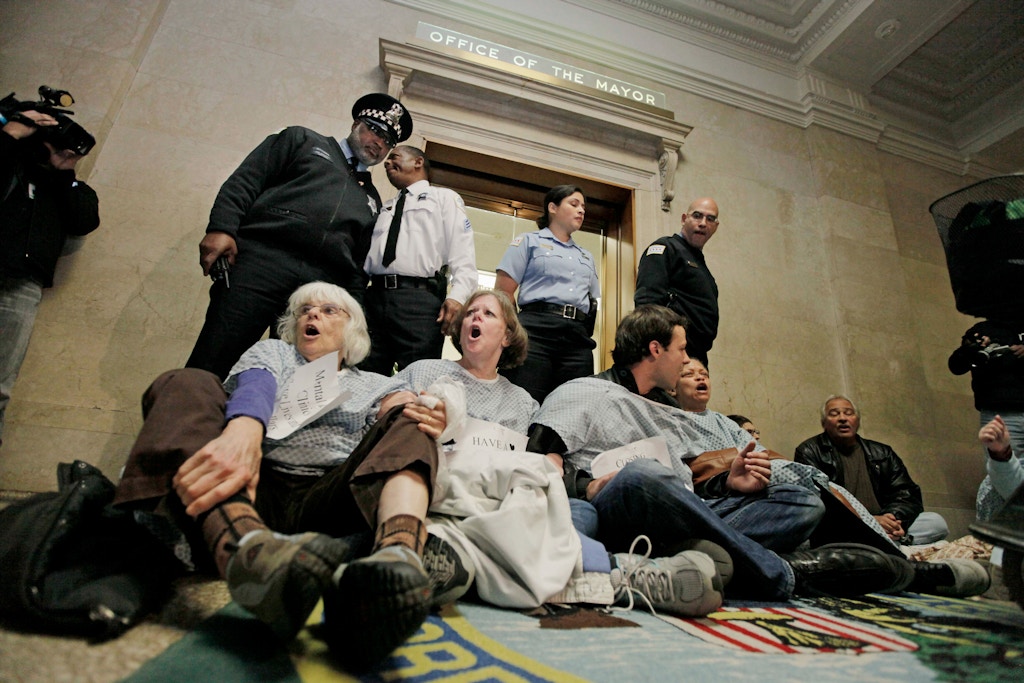
Protesters with the Mental Health Movement stage a sit-in outside Mayor Emanuel'south office on November. 15, 2011.
Photo: M. Spencer Green/AP
Mental Health Crunch
The biggest controversy of Emanuel'southward first year in office was his closing of one-half the city's public mental health clinics, most of them on the South Side. While patients were supposed to be referred to the remaining six clinics, hundreds brutal through the cracks . For months, protestors from the Mental Health Movement disrupted Emanuel'southward public appearances; they sat outside the mayor'south office and occupied one of the clinics slated for closing. They probably succeeded in preventing Emanuel from endmost the residual of the clinics in subsequent years.
But the starting time circular of closings went through, and a report published a few years later by the Collaborative for Community Wellness constitute that Chicago's Southwest Side had 0.17 licensed mental wellness clinicians per one,000 residents , compared to 4.45 per 1,000 in the wealthy Virtually North Side.
As shootings skyrocketed in Chicago neighborhoods, the need for mental health services to reduce and prevent violence as well as assistance survivors of trauma became a frequent refrain. Seven years afterwards the closings, a few months after Emanuel appear he wouldn't seek reelection, the City Council voted unanimously to plant a Public Mental Health Clinic Service Expansion Task Force to identify gaps in the city's mental health services and " explore re-opening of mental health clinics ."
Environmental Crunch
In an austerity push button during his first year in office, Emanuel eliminated the city's Department of Environs. In typical Emanuel-style messaging — which is oftentimes just a fiddling too clever — he said the indicate was to make environmental sustainability the goal of every department.
But the upshot has been a de-emphasis on environmental issues. Chicago'due south recycling rate has remained abysmally low . In Feb, an analysis by the Better Government Association and the Medill School of Journalism at Northwestern University revealed that the urban center at present has half the number of environmental inspectors that it had eight years ago , and the number of almanac inspections, not surprisingly, also brutal by more half.

Later on citywide testing in Chicago found high levels of lead in the tap water in 2018, many residents installed h2o filter systems in their homes.
Photograph: Erin Hooley/Chicago Tribune/TNS via Getty Images
"Hazardous material inspections fell by more 90 pct between 2010 and 2018; air quality inspections plunged almost 70 percent; and solid waste inspections dropped by more than lx percent," BGA and Medill reported. The Emanuel administration issued less than one-third the number of environmental citations than the city did in the preceding vii years.
And so came a devastating environmental scandal. Emanuel had begun a series of increases to homeowners' water and sewer fees — they've essentially doubled in subsequent years, with thousands of homeowners facing water shutoffs — to finance replacement of the city's aging water mains. In 2013, the EPA warned that the piece of work could increase lead levels in tap h2o by disturbing service lines to homes. ( Due to the plumbers union'south clout with the Democratic machine , Chicago required that service lines connecting homes to the city's h2o pipes exist made of lead until the mid-1980s, decades subsequently other cities had banned the toxic metal.)
For 5 years, the Emanuel administration insisted that lead levels in almanac tests were safety. But in 2018, the Chicago Tribune revealed that pb levels were above federal health standards in 30 percent of homes where homeowners had requested tests after piece of work was washed.
Emanuel rejected demands that the city assist homeowners financially in replacing service lines, as other cities have done. And when aldermen sought hearings on whether the city was violating federal law by allowing unsafe levels of lead in its water, Emanuel'southward floor leader O'Connor blocked them . Lightfoot and key aldermen now support reestablishing a separate environment department .
Education Crisis
It was on education that Emanuel tried — and failed — to make his bones as a tough, competent metropolis director and as a New Democrat willing to stand up to labor. Information technology's also an area where, judging from a contempo article past Emanuel in The Atlantic, he now hopes to frame some kind of legacy every bit an " education mayor ."
On some major points in that article, he appears to be counting on the ignorance of non-Chicago readers. He discusses recognizing the importance of principal leadership equally some kind of revelation. That's rich, knowing that Chicago Public Schools' biggest scandal during his administration — the 1 that sent CPS'south chief to federal prison — involved a master training program that principals denounced every bit depression-quality, pre-packaged, and generally irrelevant. CPS CEO Barbara Byrd-Bennett, nicknamed "B3″ by Emanuel, was sentenced to 4 1/2 years in prison afterward pleading guilty to steering the $twenty 1000000 no-bid contract through in exchange for millions of dollars in bribes and kickbacks. (Byrd-Bennett's successor, a longtime friend of Emanuel's, would go on to resign after getting caught lying to ideals investigators .) Meanwhile, the caput of the principals association says budgeting changes at CPS have handcuffed principals .
Similarly, Emanuel boasts of increased graduation rates without referring to local reporting showing that 1 factor in their rise was the introduction of alternative schools run by for-profit contractors, which operate equally diploma mills for the most difficult students. They are often storefronts in strip malls, where students spend a few hours a mean solar day at "computer learning stations" compiling credits to meet graduation requirements that are lower than those in district-run schools. Besides missing from his account is an investigation that showed graduation rates were artificially inflated by listing thousands of dropouts as "transfers."
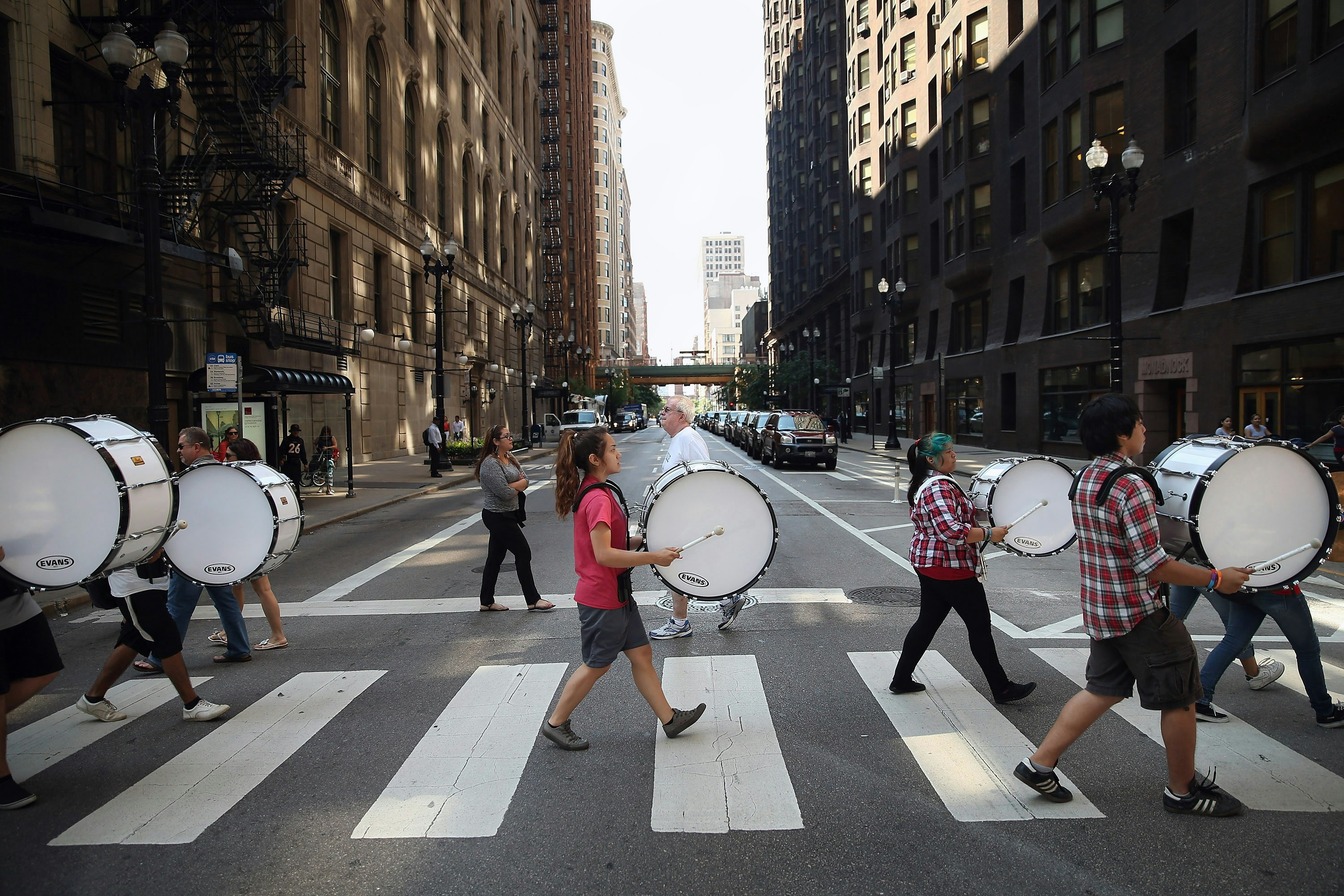
Photo: Scott Olson/Getty Images
All the statistics Emanuel cites as signs of success cover upward the hundreds of millions of dollars of upkeep cuts neighborhood schools have suffered under his spotter. His article claims he's learned the importance of wraparound services only ignores the drastic reduction in the number of counselors, social workers, and librarians he's carried out. Between 2012 and 2016, the number of schoolhouse librarians in CPS declined by 2-thirds .
The all-time index of Emanuel's failures — and of the failure of his mayorally appointed school board to provide meaningful oversight — is the fact that Chicago is now on the verge of rejecting mayoral control of schools and moving to an elected schoolhouse board .
Emanuel campaigned in 2011 promising to expand charter schools, attacking the teachers marriage as the enemy of reform. Before he was fifty-fifty sworn in, he worked with a multimillionaire schoolhouse reformer named Bruce Rauner to pass state legislation that raised the threshold for a Chicago teachers matrimony strike vote . (In his brief career in investment banking, Emanuel had aided Rauner in a deal which earned his visitor a half-billion dollars, and the ii were friends who vacationed together ; only later Rauner was elected governor equally a Republican in 2014, his budget brinksmanship , tying a settlement to his demands for anti-marriage legislation, added significantly to the fiscal woes of Chicago and its school system.) After he was elected, Emanuel's school board used an obscure contract provision to cancel the teachers' almanac enhance , claiming it was unaffordable — while diverting $58 million from CPS to the city upkeep to pay for past "security services."
Emanuel's outspoken hostility to teachers, reflecting corporate schoolhouse reformers' position that "teacher accountability" based on test scores was the primal to school comeback, certainly helped matrimony leadership win xc pct approval in a strike vote. In the 2d year of his administration, Chicago schools experienced their start teachers strike in 25 years.
Emanuel has always claimed the issue was a longer school 24-hour interval, only in fact that question had been largely settled i n a side understanding with the teachers union the summer before the strike, when CPS agreed to hire hundreds of art, music, and gym teachers so that additional time would include richer programming that had been cut at many Chicago schools. Emanuel also claims he won changes in teacher evaluation in the settlement. But the big issue was the proportion of teacher evaluations that would be based on test scores, and the contract set that proportion at the minimum established by a new land law. In fact, despite his all-time efforts to paint a prettier picture, the strike was a huge defeat for Emanuel .
The saga of Emanuel and his charter schools is even more sorry. In 2011, the two leading charter bondage in Chicago were UNO, founded past a Latino community system which had been brought into Mayor Richard J. Daley's political fold, and the Noble Network. UNO's master executive, Juan Rangel, was the co-chair of Emanuel's entrada committee and appeared frequently with the candidate. Five years later, Rangel paid a $10,000 fine to the Securities and Exchange Commission to settle charges that he'd defrauded investors by failing to disclose contracting irregularities. UNO had been defendant of covering upwardly the fact that information technology had awarded millions of dollars of building contracts to companies headed by two brothers of the grouping's main operating officer.
Emanuel's romance with Noble didn't turn out much better. In his offset campaign, he inaccurately claimed Noble high schools were among the district'south top performers. And in his first year, he contributed his enthusiastic praise for the charter network to a video by an associate of Andrew Breitbart , hosted by Juan Williams of Fob News; it posited Noble as the exemplification of school option and demonized the teachers union. Noble was later criticized for fundraising by ways of fines charged to low-income families for minor student misconduct. A fter its founder was dumped in the wake of allegations of inappropriate conduct, a new chief executive dropped its trademark naught-tolerance clothes code, which barred piercings, pilus coloring and tattoos; she actually dyed her hair imperial to symbolize the shift.
But in that location was a much bigger blow to Emanuel and the rest of the charter movement, which viewed the not-wedlock schools every bit a means of undermining teachers unions. Charter teachers began organizing, and teachers at UNO – renamed Acero after the Rangel scandal – pulled off the outset charter school teachers strike in U.S. histo ry, winning significant bacon improvements. Chicago is now the most heavily unionized charter school district in the country , and teachers at the 18 Noble schools, organizing every bit a chapter of the Chicago Teachers Spousal relationship , are pressing management there to agree not to interfere in their organizing drive.

Members of the Chicago Teachers Union hold placards outside Chicago Public School headquarters on Sept. 13, 2012, the 4th 24-hour interval of their strike.
Photo: John Gress/Corbis via Getty Images
After the 2012 strike, Emanuel'southward biggest school policy fiasco was the mass closing of fifty schools in 2013, mostly in blackness neighborhoods. This cost him the support of many blackness voters and forced him into a runoff in the election 2 years later. Emanuel'south argument at the time, that the closings were necessary due to budget constraints and "underutilization," have been parroted past local media, but activists and academics take pointed out that he opened more than 40 new charter schools in the same period . The most recent Chicago Teachers Spousal relationship contract included a cap on new charters.
In 2015, parents and community activists staged a 34-twenty-four hours hunger strike that forced Emanuel to backtrack on one of the school closings, the phaseout of Dyett High School in Bronzeville on the South Side. (A leader of the hunger strike, Jeanette Taylor, was elected to the City Quango in April.) Complaints of racism surrounding the schoolhouse closings were validated in courtroom last twelvemonth, when a Cook Canton judge blocked the first school endmost Emanuel had proposed since 2013, upholding a lawsuit by black parents charging it was racially discriminatory.
In a case of unfortunate timing for the mayor, at the fourth dimension of the school closings, he proposed a $55 million subsidy for a basketball loonshit for DePaul University under the controversial Revenue enhancement Increment Financing, or TIF, programme — a programme long criticized for diverting taxation money from schools and other purposes into a mayoral slush fund to exist awarded to favored developers. "The mayor says he has to close the schools because the city's besides bankrupt to keep them open up," columnist Ben Joravasky observed in the Chicago Reader. "Of form, every bit bankrupt as we are, at that place's withal $55 1000000 lying around to buy up some land and hand it over to private entities that don't need it."
Housing Crisis
Emanuel came into office promising to reform TIF — which collects ane-third of Chicago property taxes each twelvemonth, totaling a half-billion dollars or so — but " he's doubling down on it ," said Ald. Scott Waguespack, a leading mayoral critic. In Emanuel'due south terminal Urban center Quango meeting in March, he pushed through $2 billion in TIF subsidies for two huge luxury developments , despite the fact that both candidates running to succeed him chosen for a delay in blessing. One of those projects has been challenged in court by community and civil rights groups , arguing information technology's a perversion of the TIF program (supposedly aimed at "blighted" communities) and a perpetuation of racially discriminatory development policies.
Emanuel has had point success in attracting corporate headquarters, and his signature evolution projects — miles of bike lanes and a tourist-oriented riverfront project — have advanced Chicago's continuing as a "global metropolis." The neighborhoods haven't fared as well, a fact demonstrated by the city's ongoing loss of population; large numbers of African Americans in detail are moving to suburbs or other regions to escape poor schools and tearing streets. Concluding year, Democratic gubernatorial candidate Chris Kennedy accused Emanuel of conveying out a " strategic gentrification plan " ethnically cleansing the urban center of black people. It'south a quite plausible charge: the largest demographic growth under Emanuel by far was among young people earning more than than $100,000 a year . Meanwhile, economical development programs oasis't reached outlying communities: From 2010 to 2017, covering most of Emanuel's two terms — a period of economical recovery — the unemployment rate for black Chicagoans fell only 0.4 percent , downwards to 17.ii percent . That'southward more than double the national rate.
Initiative after initiative launched by Emanuel has failed to live upwardly to his hype. When he passed an ordinance in March 2015 expanding affordable housing requirements for developers who get city aid, he said it would create i,200 affordable housing units and generate $ninety meg for two housing funds over the next v years. Two years later, the Chicago Tribune reported that the programme had generated only 194 units and $nine.2 million in funding . When a progressive alderman championed an affordable housing development in a traditionally segregated Northwest Side neighborhood and came under attacks featuring racially charged rhetoric, Emanuel refused to back the project and said residents opposing it "need to exist heard."
The mayor and his quango allies blocked an ordinance that would have required transparency from the Chicago Housing Potency, which congenital huge cash reserves under Emanuel by slowing public housing renovation to a near halt and belongings back housing vouchers. They besides blocked an ordinance that would have limited the ability of individual aldermen to block affordable housing in their wards; historically, it's been a tool for maintaining segregation. Emanuel made sure information technology remained in identify.
Infrastructure Crunch
Another dud is Emanuel's Chicago Infrastructure Trust: a " breakout strategy" unveiled amid huge fanfare in 2012, with claims that the mayor had lined up $1 billion in private financing for building and transportation projects that would create thirty,000 jobs within three years. 2 years after, its first project got underway, an energy retrofit of municipal buildings; but instead of a public-private partnership, it was financed with a traditional bank loan. Originally described as a $200 meg projection that would create two,000 construction jobs, its scope was scaled back due to lack of investor interest. It concluded up involving simply $xiii million in projects and creating just 108 jobs , co-ordinate to the trust.
In 2017, the Sunday Times reported that the trust " has yet to raise a dime of private financing for a single public works projection," and an unnamed city official was quoted saying, "There's no alibi for the mayor to avoid endmost downward this affair that's been a complete failure." Instead, Emanuel has shifted the mission of the trust, an independent nonprofit whose board is appointed by the mayor, to procurement and contract management, tasks previously handled by city departments and the Public Edifice Committee. Its terminal human activity under his leadership was to select Elon Musk's Boring Company to construct an express railroad train to O'Hare Airport using "visionary" (and unproven) technology, a projection that is at present dead in the water .


Left/Height: People react outside of City Hall on Oct. v, 2018, afterward a jury bedevilled former police Officer Jason Van Dyke of 2d-degree murder in the 2014 shooting of Laquan McDonald. Right/Bottom: Jason Van Dyke and his attorney Daniel Herbert during Van Dyke'southward sentencing hearing in Chicago on Jan. 18, 2019. Photos: Matt Marton/AP; Antonio Perez/Chicago Tribune via AP
Policing Crisis
While instruction controversies defined Emanuel's start term, his second has been consumed with police scandals post-obit the release of video that showed the official narrative about the law shooting of Laquan McDonald in 2014 was a lie . Policing is one of the few failures of Emanuel's tenure that has gotten national attention. Suffice it to say, it was fifty-fifty worse than it seemed. Indeed, it was the mean solar day before McDonald'due south killer, Officer Jason Van Dyke, went on trial that Emanuel announced he would not seek a third term . (A jury found Van Dyke guilty of second-degree murder.)
Nearly recently, Emanuel has taken to the pages of the New York Times , which allowed him to rewrite history with a remarkably wide brush. The Chicago Tribune termed his op-ed a " revisionist history " ; national law reform adept Sam Walker, of the Academy of Nebraska, told me it's "a self-serving fairy tale."
Most every point Emanuel makes is deceptive. He points to reductions in violent law-breaking rates every bit proof of his success, merely these followed huge spikes in offense rates, which are now returning to previous levels. He claims he'southward achieved buy-in for reform by law officers without mentioning a lawsuit by the Congenial Guild of Police seeking to overturn the city's new consent decree. He said he "allowed sergeants to exert more direct leadership." In fact, the consent decree orders the metropolis to crave police supervisors to review use-of-force incidents and report misconduct, serious shortcomings highlighted past a 2017 Justice Department investigation; information technology also requires reducing the "span of control" to 10 officers for each sergeant, after the Justice Department found information technology ran as high as 1-to-35 in Chicago.
Emanuel even falsely reframes his notorious comment in 2015 that cops were beingness allowed to get " fetal ." He said, "I was articulate that police officers would 'get fetal' if they weren't included in the reform." In fact, the original Washington Post report makes perfectly articulate information technology was increased public scrutiny and accountability that Emanuel was referring to.
The biggest lie is the implication that Emanuel in any way provided leadership on police reform. An onetime-school, tough-on-crime pol – who played a key role in Clinton assistants policies that ramped upwardly mass incarceration – Emanuel resisted reform at every step of the way, including fighting against the release of the Laquan McDonald video. Even before that, his law department sought to overturn a courtroom ruling that found the existence of a code of silence in the police department, and he backed upwards his superintendent when he promoted a lieutenant who had a long history of excessive force complaints .
Following the storm of protest unleashed by the video release, Emanuel opposed a federal investigation of the police department, opposed efforts to revamp the civilian police oversight dominance and give it budgetary independence , failed to bear out a promise to establish a customs oversight board , and resisted judicial oversight through a consent decree, seeking instead to cutting a deal with then-Attorney General Jeff Sessions. Equally the Chicago Tribune points out, that consent decree came about but because the land attorney general, "determined to cake Emanuel'due south end run, forced his hand with a lawsuit," at which bespeak "Emanuel finally got on lath."
Indeed, the candidate elected to succeed Emanuel was 1 of his sharpest critics throughout the procedure. Lori Lightfoot was Emanuel's police force board president and headed a mayoral job force which went far beyond Emanuel'due south intentions in highlighting systemic racism and lack of accountability in the police department; over the following two years, Lightfoot repeatedly called out Emanuel for slow-walking reform . Certainly prospects for police force reform in Chicago improve dramatically by Emanuel'southward replacement.
If Rahm Emanuel starts showing upward on your screens more frequently in coming months, the communication of many Chicagoans would exist: "Don't believe the hype."
Source: https://theintercept.com/2019/05/20/chicago-mayor-rahm-emanuel-failures/
0 Response to "Why Rahm Emmanuel Isnt Running Again"
Postar um comentário